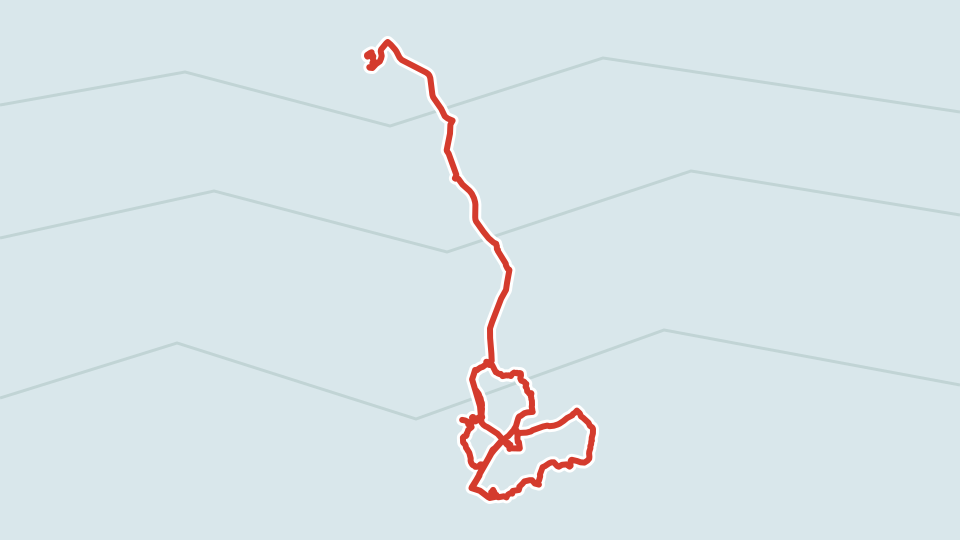
On the morning of the third day, after lubing our chains and stocking up on grub, Mike and I headed to Midreshet Ben-Gurion. The word "midreshet" might sound familiar to you — it's similar to the Arabic "madrassa", meaning religious schools, some of which train future terrorists. At least, that was my impression when I sent a Couchsurfing request: I expected to be greeted by a bearded Hasid with sidelocks in a black hat and a frock coat. But for now, we're still rolling through the desert, enjoying another warm day.


A sculpture

Mike has a shoulder injury, so he always rides uphill and never walks, to avoid pushing the bike

An incredibly picturesque road

Reminds me of Birķineļi in Latgale

The trails are excellently marked, it's almost always easy to figure out where to roll
And if you also have GPS, it's just a piece of cake; many tracks there are marked in the same color as on the signs.


The army lets schoolchildren feel the taste of victory, or rather, dry dust and sand

We reached Sde Boker — there's a rare thing here: an open body of water (artificial)
Sde Boker is a very well-known kibbutz. It's famous because this is exactly where Ben-Gurion, Israel's first prime minister, retired. He was a great supporter of developing the South (that is, the Negev desert), and set an example himself, settling here with his wife after finishing his political career, and turning into a real farmer, or rather, a kibbutznik (quite an official word, by the way, and not my twisted humor). His museum is located here, and his grave is nearby, which is why these parts serve as a place of pilgrimage for many Zionists. Previously in my mind this word had some suspicious connotations, but now I've come to believe learned that it's merely a movement for the restoration of the State of Israel. Since the restoration has de facto taken place, and in today's world, in case anyone didn't know, a state's right to exist is determined by its recognition by other states, there's no point in starting a debate. How things were before 1948 doesn't bother anyone anymore, because this is how it is now. Israel is recognized by everyone except outright marginalized states with dictatorial or pro-fundamentalist regimes. Of course, the situation might change again — but that doesn't mean some group of people has more or less right to a certain territory. However, I don't feel competent in political matters, so I have no opinion on who is right in the Arab-Israeli conflict. My opinion is universally humanistic: war and death are bad, terrorism is too. The fact that the Jews came to the desert and turned it into a prosperous state is something I can only welcome, just as I welcome any manifestations of progress and civilization in the scientific and cultural sense.

Bike shop geofun.co.il
Pretty soon we reached Midreshet Ben-Gurion and swung by a bike shop owned by Mike's friends. An amazing story happened here. At first, the owner just treated us to coffee, but then, when I tried to buy a map for $15, he refused to take the money, saying: “For Mike’s friends – priceless”. We'll forgive him his slightly funny English for the nobility of his soul and the grand gesture, which left an indelible impression on me.

The small center of the village is covered with a roof

Bicicletas
Here we met up with Vartan, my host in the midreshet. I unloaded my bags onto him, said I'd be back in the evening, and headed out with Mike for further adventures. I didn't take my camera with me; you'll get to admire the landscapes in the next part. We had a glorious ride, and I found out what a singletrack is — it's a path sort of like a road, but passable for a bike, unlike a trekking path or something similar. The singletracks in this area are quite technical, and in places I missed having a full-suspension bike. Although at that point I hadn't seen anything gnarlier yet. I got immeasurable pleasure out of it nonetheless, as would any other person. Assuming, of course, they enjoy dust on their teeth, bone-rattling shakes, pain in the muscles of their arms and legs, a handlebar jumping out of their hands with every turn of the wheel, and all this under a scorching sun.
I, for one, liked it all so much that I racked up an extra twenty kilometers from the moment Mike left me to head home alone. Honestly, I wanted to let him go so little that I even thought about returning to Revivim after reaching Mitzpe Ramon in a couple of days. But what was desired with all one's soul just recently becomes a thing of the past by tomorrow, so I will probably never see Mike again, along with a few other people I'd really love to see.
While we were getting to the midreshet in the morning, I got a flat tire, and then another one – already in the evening. And all the subsequent punctures after the first one were on the rear wheel with a regular tube, not the self-sealing one on the front. The conclusion is — either the self-sealing tube works 100 percent, or only the rear wheel was getting punctured.
In the evening, with some time to spare, I made it to the midreshet, found the student campus, and was met by my host Vartan. Here a veeery pleasant surprise awaited me: "midreshet" in Hebrew simply means "school" or "university", and not a haven for orthodox obscurantists at all. As it turned out, Midreshet Ben-Gurion is a branch of Be'er Sheva University, essentially a college town. And the students living on campus have a scientific worldview, they are materialists and skeptics — that is, the environment in which I feel most comfortable. The vibe here (like that of many other people in Israel) is purely secular, and in places even highly anti-religious, at least that's what I gathered from my conversations with Vartan and other hosts.
Vartan called his friends over, cooked us dinner (meat, meat), and we had a great time over light, cheerful conversation. The folks at the uni are from all over the world: from the USA, from Russia, Vartan himself and his sister are from Armenia, lots of people from Europe. Interestingly, in any house in Israel, there is an electric oven for heating traditional flatbreads like pita, but a microwave is far from always present.
Then we looked around a bit: took a walk around the town in the dark, looked at the buildings of different faculties. The water research faculty is the best set up: in Israel there is no topic more important, because it's a desert, after all. Vartan himself is a physicist, his friends do math and aeroponics, which is growing plants with their root systems in the air instead of soil.

I liked Midreshet Ben-Gurion as well; it's a different place than a kibbutz, but similar in many ways, since the university environment is democratic and egalitarian. Doors to dorms are often left unlocked; Vartan had to leave for Jordan early in the morning, and he suggested I just leave the keys right in the room. It's a pity I didn't spend more time in the village, but the road beckons forward, there is always something new in the future, something uncharted, full of riddles and mysteries.